Scaling Your Clothing Brand: When to Move from Small Batch to Bulk
How to know when your brand is ready to scale production. Unit cost savings, quality at volume, and the operational changes scaling demands.
 Pedro Carreira··7 min read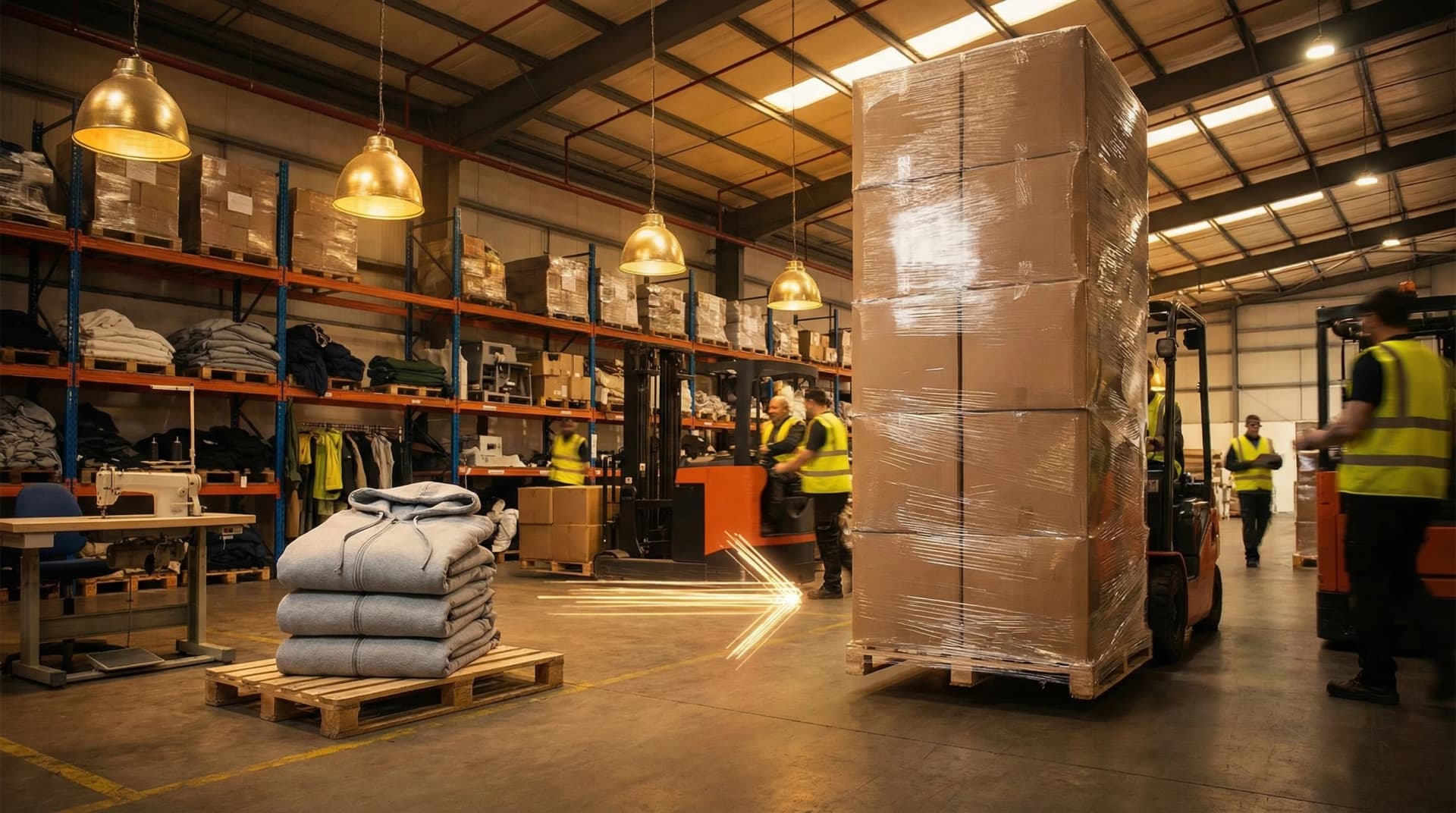
The Scaling Question
Every clothing brand that finds product-market fit eventually faces the same question: when do we scale?
You have been producing in small batches — 75 pieces here, 100 pieces there. Your bestsellers sell out. Customers ask when they will be restocked. Your margins are tight because small-batch production costs more per unit. The temptation to double or triple your order is strong.
But scaling production is not just ordering more units. It changes your cash flow, your inventory risk, your relationship with your factory, and the operational complexity of your business. Doing it at the right time and in the right way is the difference between healthy growth and overextension.
Signs Your Brand Is Ready to Scale
1. You Have Sales Data
Not assumptions — data. You know which styles sell, which colours move, and which sizes are most popular. If you are still guessing, you are not ready to scale. You are ready to run another small batch to gather more data.
2. Your Bestsellers Sell Out Consistently
If your 300 GSM hoodie in black and olive sells out within 4–6 weeks every time you restock, that is a clear signal. The demand exceeds your current production volume.
3. Your Cash Flow Can Handle Larger Orders
Scaling from 75 pieces to 500 pieces per style means your production investment multiplies. Your business needs the cash reserves or credit to handle the upfront cost — typically 50% deposit on order, balance on delivery.
4. You Have a Sales Channel That Can Move Volume
Whether it is your website, a retail partner, or a wholesale account, you need a reliable channel that can absorb larger quantities. 500 hoodies sitting in boxes for 12 months is not scaling — it is overstocking.
5. Your Factory Can Scale With You
Not all factories handle the transition from small batch to bulk smoothly. Ask your factory:
- —Can you maintain the same quality at 5x the volume?
- —What are your capacity limits per month?
- —Will the fabric be sourced from the same mill at higher volumes?
- —What are the revised lead times for larger orders?
How Scaling Affects Unit Costs
This is the primary financial incentive for scaling. Larger orders reduce your per-unit cost because fixed costs are spread across more pieces.
Where the Savings Come From
Fabric pricing — Mills offer volume discounts. Ordering 200 metres of French Terry costs more per metre than ordering 1,000 metres. At production volumes above 500 pieces per style, fabric savings of 10–20% are common.
Cutting efficiency — Larger orders mean more layers can be stacked and cut simultaneously. A cutting table that handles 50 layers produces 50 front panels in one pass. This dramatically reduces cutting time per unit.
Sewing line setup — Setting up a sewing line for a specific style involves adjusting machines, threading, and configuring the workflow. This setup cost is the same whether you are producing 75 or 750 pieces. Larger runs amortise this cost over more units.
Decoration setup — Screen printing requires screens to be prepared for each colour. The screen cost is fixed regardless of quantity. At 100 pieces, screen setup might add €1.50 per unit. At 500 pieces, it drops to €0.30 per unit.
Real Cost Examples
Based on a 350 GSM organic French Terry hoodie with chest embroidery, produced in Portugal:
Ready to manufacture your collection?
Factory-direct from Barcelos, Portugal. MOQ 50 units per style, colour and size.
Request a QuoteNo commitment · No obligation
| Quantity | Estimated Unit Cost | Saving vs 75 pcs |
|---|---|---|
| 75 pcs | €22–26 | — |
| 150 pcs | €19–23 | ~12% |
| 300 pcs | €17–20 | ~22% |
| 500 pcs | €15–18 | ~30% |
| 1,000 pcs | €13–16 | ~38% |
These are indicative — actual pricing depends on fabric, construction complexity, and decoration. But the pattern is consistent: the biggest cost reduction happens between 75 and 300 pieces. After 500 pieces, the marginal savings per additional unit diminish.
For a detailed breakdown, read our production costs guide.
What to Scale First
Do not scale your entire range simultaneously. Scale strategically.
Scale Your Bestsellers
Take your top 2–3 selling styles and increase their production volumes. These are proven products with known demand. The risk is lowest here.
Deepen Before You Widen
Instead of adding 5 new styles, increase the volume on existing styles. Add a new colourway to your bestselling hoodie instead of designing a completely new jacket. Deeper buys on fewer styles give you better pricing and simpler operations.
Add Colourways, Not Styles
Adding a new colour to an existing style is operationally simple — same pattern, same construction, just a different fabric dye lot. Adding a new style requires new sampling, new patterns, new production setup.
Phase New Styles In
If you do want to add new styles, stagger them. Launch two new styles per season rather than ten at once. This keeps your sampling budget manageable and lets you test each new style without overcommitting.
Scaling Challenges
Quality Consistency
At 75 pieces, every garment essentially receives individual attention. At 750 pieces, the production team must maintain the same standards across a longer run. Discuss quality control procedures with your factory:
- —Will every piece still be individually inspected?
- —What is the acceptable quality level (AQL)?
- —At what point do you switch from 100% inspection to statistical sampling?
At White Cotton, we maintain individual piece inspection regardless of order size. It takes more time, but it is the only way we are comfortable shipping under our clients' brands.
Fabric Consistency Across Large Orders
Large fabric orders may span multiple dye lots, which can result in slight colour variations. This is a normal reality of textile production. Managing it requires:
- —Requesting lab dip approval before production begins
- —Specifying that all fabric for one order must come from the same dye lot (if possible)
- —Accepting that between separate orders, minor colour variation may occur
Inventory Management
Larger production runs mean more inventory to store, track, and sell. Before scaling, ensure you have:
- —Adequate storage space
- —An inventory management system (even a spreadsheet works for small brands)
- —A plan for slow-moving stock (seasonal sales, bundle deals)
- —Cash flow projections that account for unsold inventory
Cash Flow Pressure
Scaling from a €5,000 production order to a €25,000 order puts five times more cash at risk. Ensure your business can absorb:
- —The production deposit (typically 50%)
- —The balance payment on delivery
- —2–3 months of carrying costs before the inventory is fully sold
When Not to Scale
Scaling is not always the right move. Hold off if:
- —You are scaling based on one good month. One strong sales period is not a trend. Wait for 3–6 months of consistent data
- —Your margins are already thin. Scaling with thin margins amplifies risk without proportionally increasing profit
- —You do not have reorder data. If customers buy once but never return, volume production will not fix a retention problem
- —You are adding debt to fund production. Taking on significant debt for a production run that may or may not sell is high-risk. Scale within your cash reserves where possible
- —Your factory is already at capacity. If your factory's lead times are stretching and quality is slipping, adding volume makes the problem worse, not better
How White Cotton Supports Scaling
We work with brands at every stage of growth. Our factory in Barcelos is sized for flexibility — we handle first-time orders of 50 pieces and repeat orders of thousands.
When brands are ready to scale, we:
- —Revisit pricing at the new volume. Larger orders unlock better unit costs, and we pass those savings through transparently
- —Discuss fabric sourcing — at higher volumes, we can negotiate better rates with our mill partners and lock in consistent fabric supply
- —Plan production scheduling — larger orders need more lead time, and we coordinate capacity planning to ensure your deadlines are met
- —Maintain quality standards — the same QC process applies whether the order is 75 or 750 pieces
If your brand is growing and you are considering scaling production, let us know. We will review your current volumes, discuss pricing at higher quantities, and help you plan the transition.

Pedro Carreira
Founder of White Cotton, a textile manufacturer in Barcelos, Portugal. Producing custom clothing collections for brands across 15+ countries.
Continue Reading
How Much Does It Cost to Start a Clothing Brand in 2026? Real Numbers
![Hoodie Manufacturing Costs: Real Prices from a Portuguese Factory [2026]](/_next/image?url=%2Fimages%2Fgenerated%2Fblog%2Fhoodie-manufacturing-costs-breakdown.webp&w=1920&q=75)
Hoodie Manufacturing Costs: Real Prices from a Portuguese Factory [2026]
![How to Find a Clothing Manufacturer in Portugal: A Factory Owner's Honest Guide [2026]](/_next/image?url=%2Fimages%2Fgenerated%2Fblog%2Fhow-to-find-clothing-manufacturer-portugal.webp&w=1920&q=75)
How to Find a Clothing Manufacturer in Portugal: A Factory Owner's Honest Guide [2026]
![How to Vet a Clothing Manufacturer: The Due Diligence Checklist [2026]](/_next/image?url=%2Fimages%2Fgenerated%2Fblog%2Fhow-to-vet-clothing-manufacturer.webp&w=1920&q=75)
How to Vet a Clothing Manufacturer: The Due Diligence Checklist [2026]
![27 Questions to Ask a Clothing Manufacturer Before Placing Your Order [2026]](/_next/image?url=%2Fimages%2Fgenerated%2Fblog%2Fquestions-to-ask-clothing-manufacturer.webp&w=1920&q=75)
27 Questions to Ask a Clothing Manufacturer Before Placing Your Order [2026]
Start your collection today
Factory-direct from Barcelos, Portugal. MOQ 50 units. Get a free quote.
Request a Quote← Previous
Portugal vs China: Why Brands Are Moving Production to Europe
Next →
Nearshoring Fashion to Europe: Why Brands Are Leaving China for Portugal [2026]
Ready to start manufacturing?
MOQ 50 pieces · Free quote · Factory-direct from Portugal