Garment Dyeing vs Piece Dyeing: Pros, Cons & When to Use Each
Understanding the two main approaches to colour in garment manufacturing. How garment dyeing and piece dyeing work, what they cost, and which method suits your brand.
 Pedro Carreira··7 min read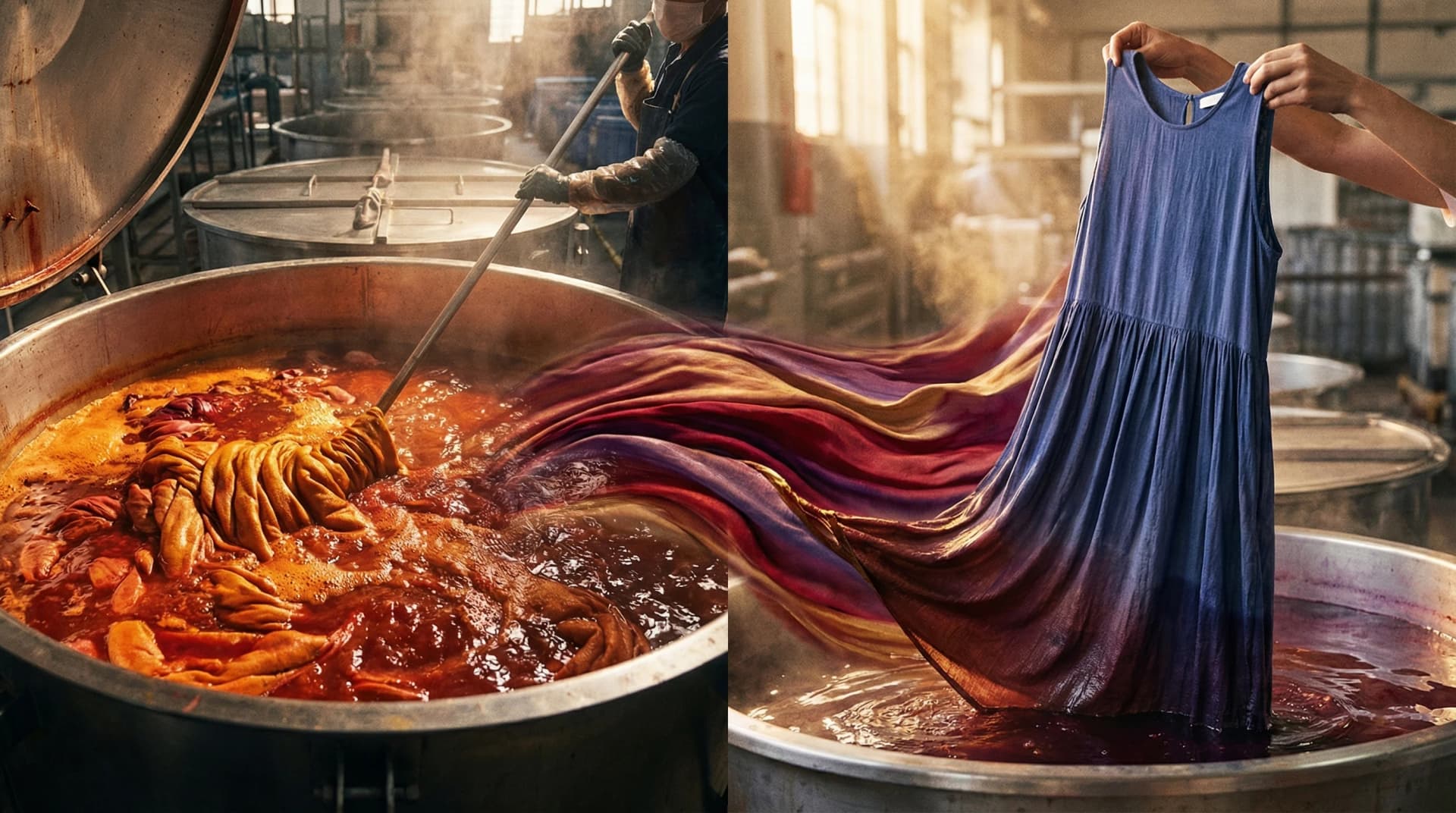
How Your Garments Get Their Colour
Every coloured garment you own got its colour through one of two fundamental processes: the fabric was dyed before cutting (piece dyeing), or the finished garment was dyed after sewing (garment dyeing).
The method used changes the look, the feel, the cost, and the production logistics. Most brands do not think about this until they are in the sampling stage — but it is one of the decisions that most significantly affects the character of the final product.
Piece Dyeing (Fabric Dyeing)
How It Works
The fabric is dyed at the mill — before it arrives at the garment factory. Large rolls of greige (undyed) fabric are loaded into industrial dyeing machines, saturated with dye, rinsed, fixed, and dried. The dyed fabric is then shipped to the factory for cutting and sewing.
Advantages
- —Colour consistency — The entire fabric roll is dyed in one batch, producing highly uniform colour across all garments
- —More colour options — Mills can match any Pantone colour with high accuracy
- —Better for multi-colour garments — If your garment uses two different fabric colours (e.g., contrast panels, colour-blocked hoods), each fabric must be piece-dyed separately
- —Standard process — This is how the vast majority of garments are produced. Every factory and mill is set up for it
- —Lower shrinkage risk — The fabric is dyed, finished, and pre-shrunk before it is cut. Shrinkage is controlled at the mill level
Disadvantages
- —Fabric MOQs — Mills typically require 300–500 metres minimum per colour for custom dyeing. At roughly 2–3 metres per garment, this translates to 100–250 pieces minimum per colour
- —Longer lead times — Custom dyeing at the mill adds 2–4 weeks before the fabric even arrives at the factory
- —Committed early — You choose your colours before production begins. Changing a colour mid-production means a new fabric order from scratch
Best For
- —Brands with established colourways and predictable demand
- —Multi-colour or colour-blocked designs
- —Large orders where fabric MOQs are easily met
- —Brands that need precise, consistent Pantone matching across orders
Garment Dyeing
How It Works
The garment is cut and sewn from undyed (greige or white) fabric. The fully assembled garment — stitching, labels, and all — is then placed into an industrial dyeing machine and dyed as a complete piece.
Advantages
- —Unique aesthetic — Garment dyeing produces a softer, more lived-in look. The dye absorbs differently at seams, hems, and fabric intersections, creating subtle colour variations that look artisanal and organic. This "washed" or "vintage" aesthetic is highly popular in contemporary and premium fashion
- —Fabric flexibility — You only need undyed fabric, which is readily available and does not require colour-specific mill orders. This effectively eliminates the fabric colour MOQ
- —Late colour decisions — You can produce garments in white/greige and decide on the final colour later. This is powerful for responsive brands that want to react to demand
- —Softer hand feel — The dyeing and washing process softens the garment. A garment-dyed hoodie feels like it has been worn and washed a dozen times — in a good way
- —Lower inventory risk — Produce a batch of undyed garments and dye them in small quantities as needed. You can test a new colour with 30–50 pieces instead of committing to 200+
Disadvantages
- —Colour variation — Because the dye interacts with the assembled garment (which has varying fabric thicknesses at seams, ribbing, and hems), colour is never perfectly uniform. This is a feature for some brands and a defect for others
- —Shrinkage — Garment dyeing involves heat and water, which causes shrinkage. Patterns must be adjusted (typically 5–8% larger) to account for this. The shrinkage rate must be tested and confirmed before production
- —Thread and trim compatibility — Sewing thread, labels, and trims must be compatible with the dye process. Polyester thread will not absorb cotton dye, resulting in white stitching on a coloured garment (which can be a deliberate design choice, or a problem)
- —Limited colour range — Garment dyeing works best with mid-tones and muted colours. Achieving very dark or very bright colours consistently is harder
- —Higher per-unit cost — Garment dyeing is more labour-intensive and requires more quality control than piece dyeing
Best For
- —Brands wanting a vintage, washed, or artisanal aesthetic
- —Smaller runs where fabric colour MOQs are a barrier
- —Brands that want colour flexibility and responsive production
- —Premium and contemporary fashion positioning
- —Streetwear and heritage-inspired brands
Cost Comparison
| Factor | Piece Dyeing | Garment Dyeing |
|---|---|---|
| Fabric cost | Higher (custom-dyed fabric) | Lower (greige/white fabric) |
| Dyeing cost | Included in fabric price | Additional per-garment cost |
| Pattern adjustment | Standard patterns | Requires oversized patterns (+5–8%) |
| Shrinkage testing | Handled at mill | Required at factory level |
| Thread/trim cost | Standard | May need dye-compatible trims |
| QC requirements | Standard | Higher (colour variation checking) |
| Net per-unit cost | Lower for large runs | Higher overall, but lower minimum investment |
For a hoodie at 500 pieces:
Ready to manufacture your collection?
Factory-direct from Barcelos, Portugal. MOQ 50 units per style, colour and size.
Request a QuoteNo commitment · No obligation
- —Piece-dyed: The fabric cost includes the dyeing. Net production cost is standard
- —Garment-dyed: Add approximately €2–4 per garment for the dyeing process, plus additional QC time
For more on cost structures, read our production costs breakdown.
Combining Both Methods
Some of our most interesting projects use both methods on the same garment:
- —Piece-dyed body with garment overdye — A pre-dyed fabric gets an additional garment-dye wash, creating a layered colour effect
- —Contrast stitching — Use polyester thread (which resists dye) on a garment-dyed piece for deliberately contrasting white stitch lines
- —Selective dyeing — Dip-dye or spray effects applied to assembled garments for unique colour patterns
These techniques are more complex and require experience, but they create products that are genuinely distinctive.
Garment dyeing is often combined with wash treatments that further enhance the aesthetic:
Enzyme Wash
Enzymes break down surface fibres, creating a softer, smoother hand feel. Used after garment dyeing to enhance the washed-out, lived-in look.
Stone Wash
Physical abrasion using pumice stones creates visible surface texture and colour variation. More dramatic than enzyme wash.
Acid Wash
Creates high-contrast colour patterns with an intentionally uneven, distressed appearance. A specific aesthetic choice, not suitable for all brands.
Silicone Wash
Adds a silky, smooth hand feel to the garment. Often used as a final finishing step after garment dyeing.
At White Cotton, we offer enzyme wash, stone wash, and garment dyeing as part of our finishing capabilities — all done in-house or with trusted local partners in the Barcelos area.
Making the Decision
Choose Piece Dyeing If:
- —You need exact Pantone colour matching
- —Colour consistency across the entire order is critical
- —You are producing multi-colour or colour-blocked garments
- —Your order volumes comfortably meet fabric MOQs (150+ pieces per colour)
- —You want a clean, uniform appearance
Choose Garment Dyeing If:
- —You want a soft, vintage, lived-in aesthetic
- —You need flexibility to test new colours in small quantities
- —Your brand values an artisanal, organic look
- —You are comfortable with slight colour variation between pieces
- —You want to avoid fabric colour MOQs
Ask Your Factory
Not every factory offers garment dyeing. It requires specialised equipment, experience with shrinkage calculations, and quality control processes specific to the technique.
At White Cotton, we work with both methods daily. If you are unsure which approach is right for your product, send us your concept and we will recommend the best path based on your design, your volumes, and your aesthetic goals.

Pedro Carreira
Founder of White Cotton, a textile manufacturer in Barcelos, Portugal. Producing custom clothing collections for brands across 15+ countries.
Continue Reading
Cotton vs Polyester: Which Fabric Is Right for Your Clothing Brand?
French Terry vs Fleece: Which Fabric for Your Hoodies & Sweatshirts?
Sweatshirt Production: Fabrics, Construction & What to Ask Your Factory
Understanding Fabric Weights: A Complete Guide for Fashion Brands
How Much Does It Cost to Start a Clothing Brand in 2026? Real Numbers
Start your collection today
Factory-direct from Barcelos, Portugal. MOQ 50 units. Get a free quote.
Request a Quote← Previous
Barcelos Textile Industry — Portugal's Factory Capital [Inside Look]
Next →
Screen Printing vs DTG vs Embroidery: Choosing the Right Decoration Method
Ready to start manufacturing?
MOQ 50 pieces · Free quote · Factory-direct from Portugal