Screen Printing vs DTG vs Embroidery: Choosing the Right Decoration Method
A manufacturer's guide to garment decoration methods. Cost comparison, quality differences, and when to use screen printing, DTG, DTF, or embroidery.
 Pedro Carreira··9 min read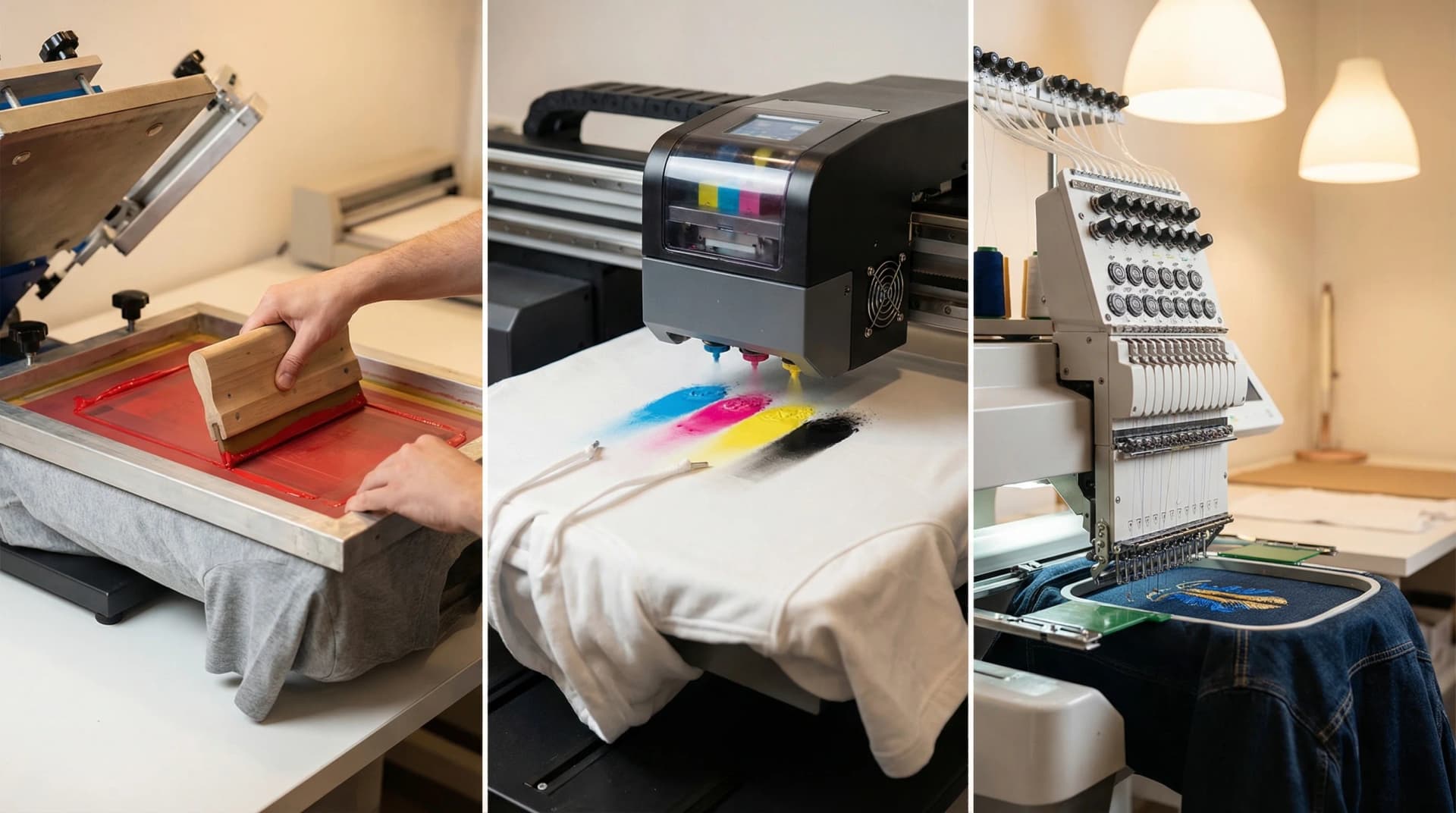
Decoration Defines the Product
The garment is the canvas. The decoration — the print, the embroidery, the finish — is what makes it yours. It is what customers see first, what they photograph, what makes them choose your hoodie over the one next to it.
Choosing the right decoration method is not just an aesthetic decision. It affects your cost per unit, your minimum quantities, the fabric types you can use, and how the garment ages over time. At White Cotton, a clothing manufacturer in Portugal, we offer all major decoration methods in-house, and we advise brands on the best match for their design every day.
Screen Printing
Screen printing is the oldest and most widely used method for garment decoration. Ink is pushed through a mesh screen (one per colour) onto the fabric surface.
How It Works
- 1.Your design is separated into individual colour layers
- 2.Each colour layer is exposed onto a separate mesh screen
- 3.The garment is placed on a printing pallet
- 4.Each screen is aligned and ink is pushed through with a squeegee
- 5.The garment passes through a dryer to cure the ink
Ink Types
- —Water-based ink — Absorbs into the fabric fibres. Produces a soft, vintage feel with no raised texture. The print becomes part of the fabric. Our recommended option for premium brands
- —Plastisol ink — Sits on top of the fabric surface. More opaque, more vibrant, slightly raised feel. Better colour coverage on dark fabrics
- —Discharge ink — Removes the fabric dye and replaces it with the print colour. Creates an ultra-soft print on dark fabrics. Only works on 100% cotton
- —Specialty inks:
- Puff ink — Expands when heated, creating a raised 3D texture
- Foil — Metallic finish (gold, silver, holographic)
- Flock — Velvet-like texture
- Glow-in-the-dark — Phosphorescent ink that glows after light exposure
- High-density — Thick, raised print with a rubber-like feel
Cost Structure
- —Setup cost: €25–50 per screen (one screen per colour). This is a fixed cost regardless of quantity
- —Print cost: €0.50–2.00 per print per colour, decreasing with volume
- —Effective cost at 100 pieces (2-colour print): €2.50–5.00 per unit
- —Effective cost at 500 pieces (2-colour print): €1.00–2.50 per unit
Advantages
- —Excellent colour vibrancy and opacity
- —Most durable decoration method (outlasts the garment)
- —Cost-effective at higher quantities (200+ pieces)
- —Wide range of specialty effects (puff, foil, flock, etc.)
- —Works on all fabric types
Disadvantages
- —Setup cost makes it expensive for small runs (under 50 pieces)
- —Each colour requires a separate screen — costs increase with colour count
- —Not suitable for photographic or gradient designs (halftone patterns are possible but limited)
- —Design changes require new screens
Best For
- —Bold, limited-colour designs (1–4 colours)
- —Runs of 100+ pieces per design
- —Brands wanting specialty effects (puff, foil, flock)
- —Chest logos, back prints, sleeve prints
DTG (Direct to Garment)
DTG uses a modified inkjet printer to print directly onto the garment surface. Think of it as an inkjet printer for fabric.
How It Works
- 1.The garment is pre-treated with a bonding solution (for dark fabrics)
- 2.The garment is placed flat on the printer bed
- 3.The printer deposits water-based ink directly onto the fabric surface
- 4.The print is heat-cured to fix the ink
Cost Structure
- —Setup cost: None (no screens to prepare)
- —Print cost: €3–8 per print (varies by print size and ink coverage)
- —Cost is virtually the same regardless of quantity — printing one piece costs the same per unit as printing 500
Advantages
- —No setup costs — economical for small runs and samples
- —Unlimited colours in a single pass
- —Photographic quality — gradients, photographs, and complex artwork all print cleanly
- —No minimum quantity — print one piece if needed
- —Quick turnaround — no screen preparation required
Disadvantages
- —Higher per-unit cost than screen printing at volume (crossover point is typically 100–150 pieces)
- —Print durability is good but not equal to screen printing — slight fading over many washes
- —Works best on 100% cotton. Performance on polyester blends varies
- —Print area is limited by the printer bed size
- —Fabric texture affects quality — smoother fabrics (French Terry exterior) produce better results than heavily textured fabrics (brushed fleece exterior)
Best For
- —Complex, multi-colour artwork
- —Photographic or gradient designs
- —Small runs and samples (1–100 pieces)
- —Testing designs before committing to screen printing
DTF (Direct to Film)
DTF is a newer method that bridges the gap between DTG and screen printing.
Ready to manufacture your collection?
Factory-direct from Barcelos, Portugal. MOQ 50 units per style, colour and size.
Request a QuoteNo commitment · No obligation
How It Works
- 1.The design is printed onto a special PET film
- 2.A hot-melt adhesive powder is applied to the wet ink
- 3.The film is cured
- 4.The film is heat-pressed onto the garment, transferring the design
Cost Structure
- —Setup cost: Minimal (film preparation)
- —Print cost: €2–6 per transfer (varies by size)
- —Effective cost at 100 pieces: €3–5 per unit
- —Effective cost at 500 pieces: €2–4 per unit
Advantages
- —Works on any fabric type and colour (cotton, polyester, blends, dark fabrics)
- —No pre-treatment required (unlike DTG on dark fabrics)
- —Good colour vibrancy and opacity
- —Moderate cost at both low and medium volumes
- —Full-colour capability like DTG
Disadvantages
- —Slight plastic feel on the printed area (the adhesive layer creates a film-like texture)
- —Less breathable than water-based screen printing or DTG
- —Print longevity is good but below screen printing
- —Edges can be visible on close inspection (the transfer film boundary)
Best For
- —Full-colour designs on dark or polyester fabrics
- —Medium-volume runs (50–500 pieces)
- —Brands wanting colour flexibility without screen setup costs
Embroidery
Thread is stitched directly into the fabric using digitally-controlled embroidery machines.
How It Works
- 1.Your design is digitised — converted into a stitch file that tells the machine exactly where to place each stitch
- 2.The garment is hooped (stretched on a frame to maintain tension)
- 3.The embroidery machine stitches the design using coloured threads
- 4.The hoop is removed and any backing stabiliser is trimmed
Embroidery Types We Offer
- —Flat embroidery — Standard embroidery. Clean, professional, the industry standard for logos and brand marks
- —3D/Puff embroidery — Foam is placed under the stitching to create a raised, dimensional effect. Popular for streetwear and caps
- —Chenille — Thick, looped thread creates a textured, varsity-style effect. High-impact and tactile
- —Chain stitch — A single-thread stitch that creates a slightly irregular, handcrafted look. Vintage-inspired
- —Appliqué — A fabric patch is cut and stitched onto the garment. Combines fabric and thread for a multi-dimensional effect
Cost Structure
- —Digitising fee: €20–50 per design (one-time cost for converting artwork to stitch file)
- —Embroidery cost: Priced per 1,000 stitches, typically €1.00–1.50 per 1,000 stitches
- —Small chest logo (5,000–8,000 stitches): €1.50–3.00 per unit
- —Large back embroidery (20,000–40,000 stitches): €5.00–12.00 per unit
- —3D/Puff: Add 20–30% to standard embroidery pricing
- —Chenille: Add 40–60% to standard embroidery pricing
Advantages
- —Premium perceived value — embroidery is universally associated with quality
- —Extremely durable — outlasts the garment
- —Works beautifully on heavyweight fabrics (hoodies, sweatshirts, jackets)
- —No colour limitations on fabric — thread colour is independent of fabric colour
- —Tactile, dimensional quality that printing cannot replicate
Disadvantages
- —Not suitable for photographic or highly detailed designs (minimum detail size ~1mm)
- —Cost increases with stitch count — large, complex designs become expensive
- —Can pucker lightweight fabrics (not ideal for sub-180 GSM t-shirts)
- —Maximum practical size is limited (full-back embroidery is possible but expensive)
Best For
- —Logos and brand marks (chest, sleeve, back of neck)
- —Premium and luxury positioning
- —Hoodies, sweatshirts, jackets, polos, caps
- —Designs that benefit from texture and dimension
Comparison Table
| Factor | Screen Print | DTG | DTF | Embroidery |
|---|---|---|---|---|
| Setup cost | €25–50/colour | None | Minimal | €20–50 digitising |
| Per-unit cost (100 pcs) | €1.50–4.00 | €3–8 | €3–5 | €1.50–8.00 |
| Colour limit | 1–6 practical | Unlimited | Unlimited | 1–12 threads |
| Best quantity | 100+ | 1–100 | 50–500 | Any |
| Durability | Excellent | Good | Good | Excellent |
| Fabric compatibility | All | Best on cotton | All | All (180+ GSM) |
| Feel | Varies by ink | Soft | Slight film | Dimensional |
| Detail level | Good | Excellent | Very good | Moderate |
Combining Methods
Many of our strongest products combine multiple decoration methods:
- —Embroidered chest logo + screen-printed back design — Premium front branding with a bold graphic on the back
- —DTG sample + screen print production — Use DTG for sampling and photography, switch to screen printing for the production run to save on cost
- —Puff embroidery + flat embroidery — Mix dimensions within a single design for visual interest
- —Garment dye + screen print — Print on a garment-dyed piece for a vintage, integrated look (requires testing for ink adhesion)
Our Recommendation
Start with the design, not the method.
- 1.Simple logo, few colours? → Screen printing (100+ pcs) or embroidery
- 2.Complex artwork, many colours? → DTG (small runs) or screen printing with halftone (large runs)
- 3.Premium brand, tactile quality? → Embroidery
- 4.Testing a new design? → DTG for samples, then screen printing for production
- 5.Dark fabrics, full colour? → DTF or plastisol screen printing
At White Cotton, we do all of this in-house — embroidery, screen printing, and digital printing. We can sample in one method and produce in another. Send us your artwork and we will recommend the best approach for your design, your quantities, and your budget. Related: garment certifications guide, t-shirt manufacturing Portugal, hoodie manufacturing guide.

Pedro Carreira
Founder of White Cotton, a textile manufacturer in Barcelos, Portugal. Producing custom clothing collections for brands across 15+ countries.
Continue Reading
Your First Clothing Sample: What to Expect, What It Costs & Timeline
Manufacturing Oversized Streetwear: Patterns, Fabrics & Production Tips
Polo Shirt Manufacturing: Piqué, Jersey & Premium Construction
How Joggers Are Made: The Complete Manufacturing Process
![Hoodie Manufacturing Guide: Fabric, GSM, Costs & Construction [2026]](/_next/image?url=%2Fimages%2Fgenerated%2Fblog%2Fhoodie-manufacturing-guide.webp&w=1920&q=75)
Hoodie Manufacturing Guide: Fabric, GSM, Costs & Construction [2026]
Start your collection today
Factory-direct from Barcelos, Portugal. MOQ 50 units. Get a free quote.
Request a Quote← Previous
Garment Dyeing vs Piece Dyeing: Pros, Cons & When to Use Each
Next →
GSM Fabric Weight Chart — T-Shirts, Hoodies & Sweatshirts
Ready to start manufacturing?
MOQ 50 pieces · Free quote · Factory-direct from Portugal