Clothing Brand Business Plan: The Manufacturer's Perspective
What your clothing brand business plan should include from a production standpoint. Collection planning, MOQs, cash flow, and the mistakes we see new brands make.
 Pedro Carreira··8 min read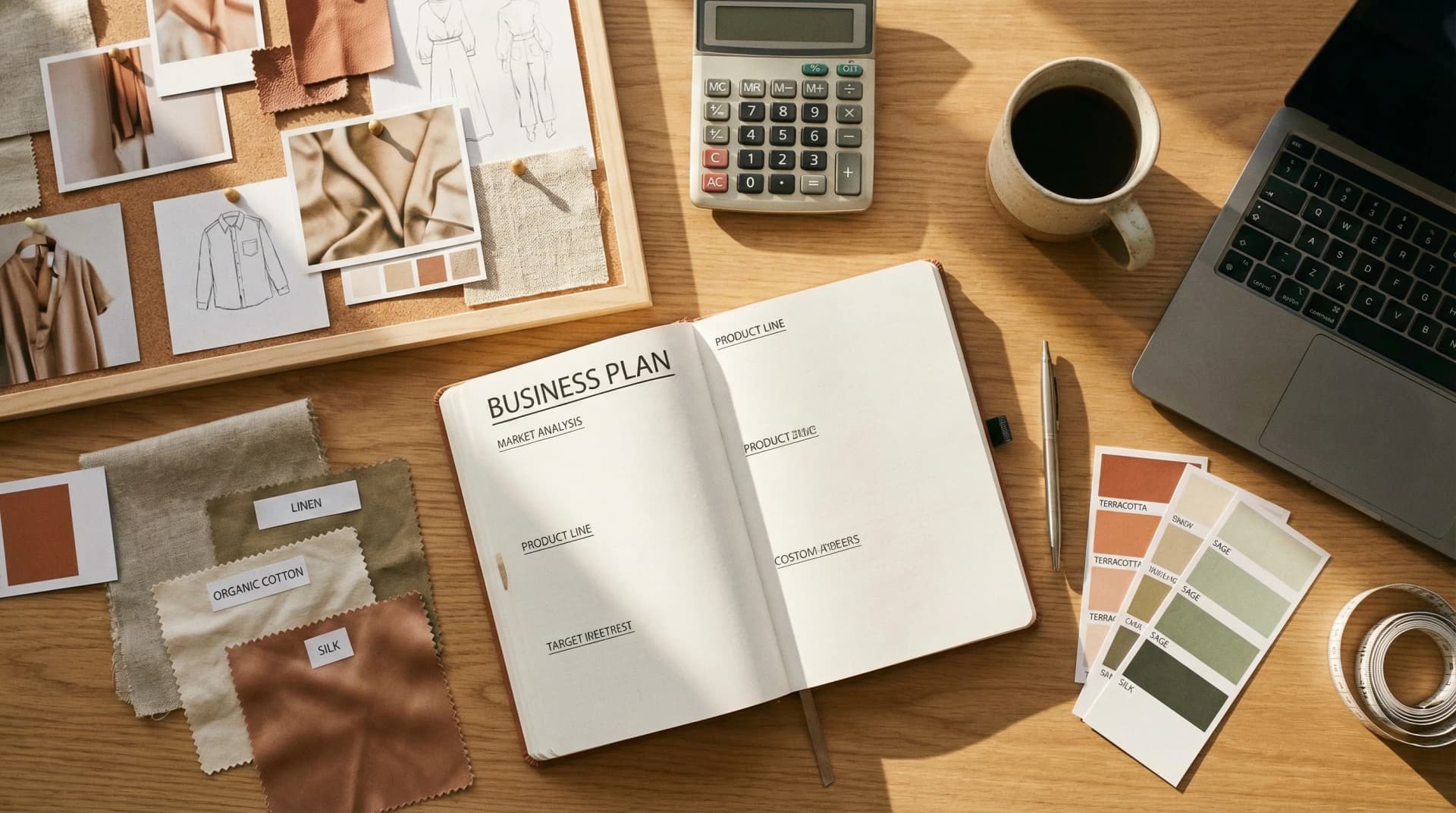
What We Wish Every New Brand Knew
Every week we receive enquiries from brands with ambitious plans — 20 styles, 8 colourways each, custom fabrics, embroidery on every piece, matching packaging, and a launch date three weeks away.
The enthusiasm is admirable. The plan is not.
After working with hundreds of brands — from first-time founders to established labels — we have seen which business plans lead to successful production runs and which ones stall at the sampling stage. The difference is rarely the design. It is the production planning.
This guide is not about marketing strategies or brand identity (those matter, but that is not our expertise). This is about the parts of your business plan that directly affect manufacturing — and the gaps we see most often.
Start Fewer, Start Better
The single most impactful piece of advice we give to new brands: start with 3–5 core styles, not 20.
Here is why:
Sampling Costs Multiply Fast
Each style requires 2–3 sample rounds at €80–200 per sample. Five styles means €800–3,000 in sampling alone. Twenty styles means €3,200–12,000 — before you have sold a single garment.
MOQs Apply Per Style, Per Colour
If your minimum is 75 pieces per style per colour, five styles in two colours is 750 pieces total. Twenty styles in two colours is 3,000 pieces. That is a dramatically different investment.
Fewer Styles = Better Quality
When you concentrate your budget on fewer styles, you can afford better fabrics, better construction, and more attention to detail. A five-style collection at 350 GSM organic French Terry makes a stronger impression than a twenty-style collection at 200 GSM conventional cotton.
You Learn Faster
Your first collection is a test. You are learning what sells, what your customers respond to, and what your brand actually is. It is far cheaper to learn these lessons with five styles than with twenty.
Our recommendation: Launch with 3–5 core pieces. A heavyweight hoodie, a premium t-shirt, a crewneck sweatshirt, and joggers is a strong starting collection. If you want to go even simpler, start with just a hoodie and a t-shirt.
The Production Plan Your Business Plan Needs
Most clothing brand business plans include sections on target market, brand identity, marketing channels, and revenue projections. Few include a realistic production plan. Here is what yours should cover.
Collection Calendar
Plan your collections around production timelines, not around when you want to launch.
- —Sampling: 6–10 weeks from brief to approved PP sample
- —Production: 3–5 weeks for bulk manufacturing
- —Shipping: 2–5 days within Europe, 2–4 weeks for international
- —Photography and marketing: 2–4 weeks after receiving stock
Work backwards from your launch date. If you want to launch in September, you need to begin sampling in May at the latest.
Also consider seasonality:
- —Spring/Summer collections should enter production in January–March
- —Autumn/Winter collections should enter production in June–August
- —Factory capacity fills up during peak seasons (August–October for AW production). Book your slots early
Bill of Materials (BOM)
For each style, document:
- —Fabric (type, GSM, composition, colour)
- —Trims (labels, hang tags, drawcords, zips, buttons)
- —Decoration (print method, embroidery details, placement)
- —Packaging (polybags, branded boxes, tissue paper)
This is not just for the factory — it is for your own budgeting. Every component has a cost, and the BOM is how you track them.
Size Run Planning
Decide your size range and the quantity distribution within it.
Ready to manufacture your collection?
Factory-direct from Barcelos, Portugal. MOQ 50 units per style, colour and size.
Request a QuoteNo commitment · No obligation
A common distribution for a first order:
| Size | % of Order |
|---|---|
| XS | 5–8% |
| S | 15–20% |
| M | 25–30% |
| L | 25–30% |
| XL | 15–20% |
| XXL | 5–8% |
If you have data from pre-orders or past sales, use it. If not, the distribution above is a safe starting point. You can adjust for subsequent orders based on actual sell-through.
Pricing Strategy (Cost-Based)
Many brands price their products based on what competitors charge. That is a starting point, but your pricing must cover your actual production costs plus margin.
A healthy pricing structure for a direct-to-consumer brand:
- —Production cost (fabric + manufacturing + decoration + labels + packaging): This is your landed cost per unit
- —Retail price: Typically 3–5x the production cost for DTC, 2–2.5x for wholesale
- —Example: A hoodie that costs €20 to produce should retail at €60–100 DTC or wholesale at €40–50
For a detailed breakdown of what production actually costs, read our clothing production costs guide.
Cash Flow: The Silent Killer
More clothing brands fail from cash flow problems than from bad design. Manufacturing requires significant upfront investment, and the money goes out long before it comes back.
The Cash Flow Timeline
- 1.Month 1–2: Sampling costs (€1,000–3,000 for 3–5 styles)
- 2.Month 2–3: Production deposit (typically 50% of the total order value)
- 3.Month 3–4: Balance payment on delivery (remaining 50%)
- 4.Month 4–5: Photography, marketing, website updates
- 5.Month 5–6: Launch and first sales begin
- 6.Month 6–8: Revenue starts covering costs
From your first sampling payment to your first revenue, expect 5–8 months of cash outflow. Your business plan needs to account for this gap.
Realistic First-Collection Budget
For a brand launching with 4 core styles, 2 colourways each, at minimum quantities:
| Cost Category | Estimate |
|---|---|
| Sampling (3 rounds × 4 styles) | €1,500–3,000 |
| Production (600 pieces total) | €6,000–12,000 |
| Labels and packaging | €500–1,000 |
| Shipping | €300–800 |
| Photography | €500–2,000 |
| Website | €0–3,000 |
| Total | €8,800–21,800 |
These numbers are not meant to discourage — they are meant to prepare. A well-planned first collection can be launched for under €10,000 if you start lean. Read more about how to start a clothing brand with realistic expectations.
Collection Planning for Manufacturing Efficiency
How you design your collection directly affects your production costs. A manufacturing-efficient collection is not a boring one — it is a smart one.
Use Shared Fabrics
If your hoodie, sweatshirt, and joggers all use the same 350 GSM organic French Terry, the factory can source one large fabric order instead of three small ones. This reduces:
- —Fabric cost (volume discount from the mill)
- —Lead time (one fabric order, not three)
- —Risk (one fabric lot to match, not three)
Use Shared Trims
Standardise your labels, hang tags, and drawcords across styles. Custom trims for every style multiplies costs and complexity.
Limit Colourways Initially
Two or three colours is enough for a first collection. Each additional colour means:
- —A separate dye lot at the mill
- —A separate fabric QC check
- —A separate production run at the factory
- —More inventory to manage
Group Decoration Methods
If some styles need screen printing and others need embroidery, that is fine. But if one style needs screen printing, DTG, puff embroidery, and foil print, the production complexity (and cost) escalates quickly. Keep decoration consistent where possible.
Mistakes We See in Business Plans
No Production Timeline
"We want to launch in October" with no sampling calendar, no fabric lead time consideration, and no buffer for the inevitable sample revisions. Build in at least 4 months from first enquiry to finished stock.
Unrealistic MOQ Expectations
"We want 20 pieces of each colour to test." Most quality factories cannot produce at these quantities profitably. If your plan requires testing with quantities under 50 per style, consider starting with a white-label programme instead.
No Contingency Budget
Fabric shipments get delayed. Samples need extra rounds. Pantone colours do not match on the first dye lot. Build a 15–20% contingency into your production budget.
Pricing Before Costing
Setting a retail price of €45 for a hoodie before knowing that the production cost is €22 leaves you with margins too thin to sustain a business — especially when marketing costs, returns, and shipping eat into that gap.
Ignoring Reorder Planning
Your business plan should address what happens after the first collection sells. How quickly can you reorder? What is the minimum reorder quantity? How will you handle sizing adjustments based on sales data?
At White Cotton
We are not business consultants — we are manufacturers. But after decades on the factory floor, we have seen which brands succeed and which ones struggle. The brands that plan their production carefully, start lean, and build on what works are the ones we are still producing for years later.
If you are building your business plan and want to understand what production will actually cost, send us your concept. We provide detailed quotations within 48 hours — fabric costs, manufacturing, decoration, labels, everything broken down. No commitment required.

Pedro Carreira
Founder of White Cotton, a textile manufacturer in Barcelos, Portugal. Producing custom clothing collections for brands across 15+ countries.
Continue Reading
How Much Does It Cost to Start a Clothing Brand in 2026? Real Numbers
![Hoodie Manufacturing Costs: Real Prices from a Portuguese Factory [2026]](/_next/image?url=%2Fimages%2Fgenerated%2Fblog%2Fhoodie-manufacturing-costs-breakdown.webp&w=1920&q=75)
Hoodie Manufacturing Costs: Real Prices from a Portuguese Factory [2026]
![How to Find a Clothing Manufacturer in Portugal: A Factory Owner's Honest Guide [2026]](/_next/image?url=%2Fimages%2Fgenerated%2Fblog%2Fhow-to-find-clothing-manufacturer-portugal.webp&w=1920&q=75)
How to Find a Clothing Manufacturer in Portugal: A Factory Owner's Honest Guide [2026]
![How to Vet a Clothing Manufacturer: The Due Diligence Checklist [2026]](/_next/image?url=%2Fimages%2Fgenerated%2Fblog%2Fhow-to-vet-clothing-manufacturer.webp&w=1920&q=75)
How to Vet a Clothing Manufacturer: The Due Diligence Checklist [2026]
![27 Questions to Ask a Clothing Manufacturer Before Placing Your Order [2026]](/_next/image?url=%2Fimages%2Fgenerated%2Fblog%2Fquestions-to-ask-clothing-manufacturer.webp&w=1920&q=75)
27 Questions to Ask a Clothing Manufacturer Before Placing Your Order [2026]
Start your collection today
Factory-direct from Barcelos, Portugal. MOQ 50 units. Get a free quote.
Request a Quote← Previous
Portugal vs Turkey: Clothing Manufacturing Costs Compared
Next →
Portugal vs China: Why Brands Are Moving Production to Europe
Ready to start manufacturing?
MOQ 50 pieces · Free quote · Factory-direct from Portugal