T-Shirt Manufacturing in Portugal: From Cotton to Finished Product
A complete guide to t-shirt manufacturing in Portugal — fabric types, construction methods, GSM weights, printing options, and what to expect when working with a Portuguese t-shirt manufacturer.
 Pedro Carreira··13 min read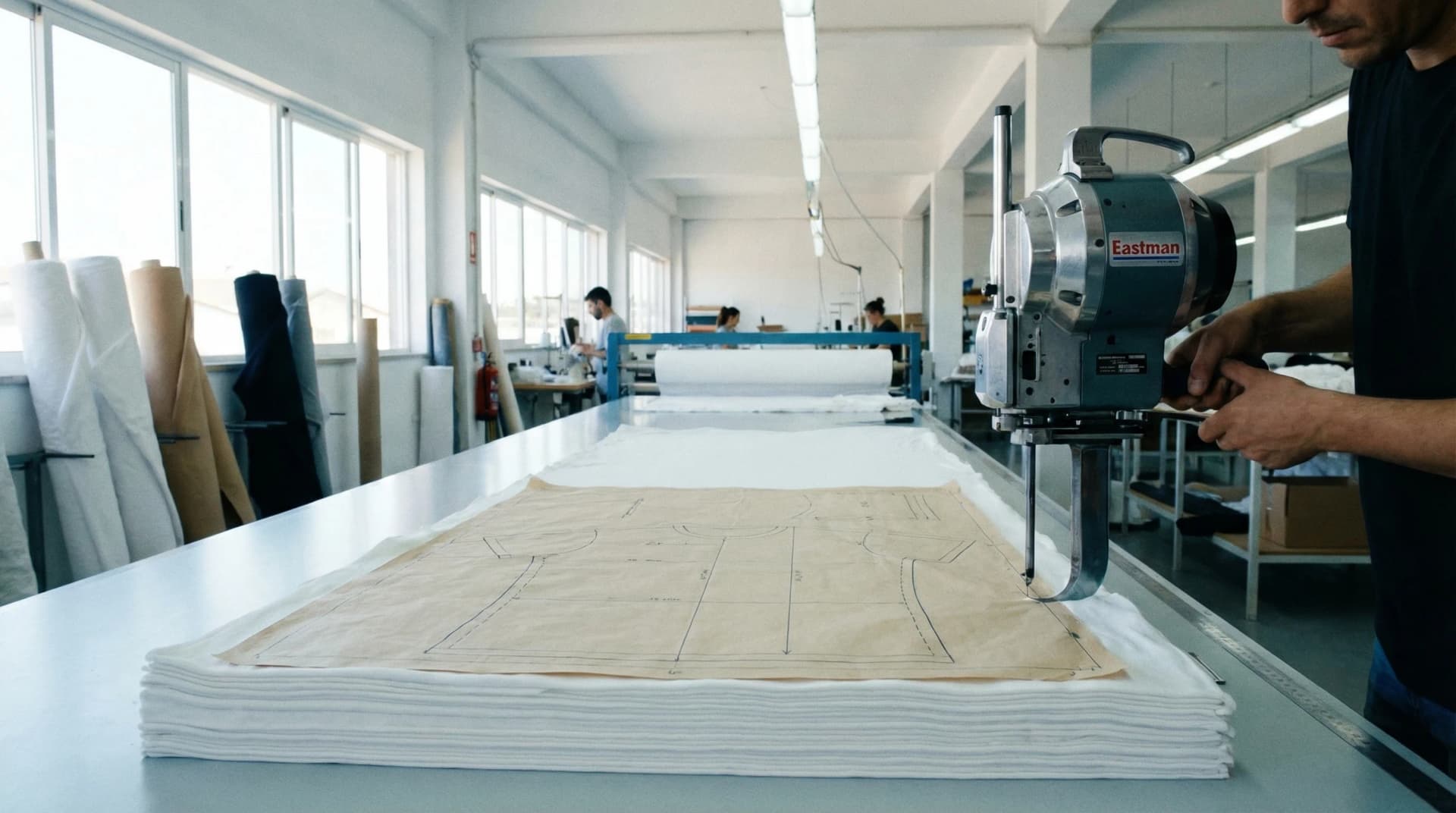
Why Portugal for T-Shirt Manufacturing?
Portugal is one of Europe's most established textile manufacturing countries, with a history that stretches back centuries. The northern region — where we are located in Barcelos, roughly 40 minutes from Porto — is the heart of this industry. In a relatively small geographic area, you will find spinning mills, fabric mills, dyehouses, cut-and-sew factories, and finishing specialists operating in close proximity. That concentration of expertise is difficult to replicate.
For t-shirt manufacturing specifically, Portugal offers something that Asian sourcing rarely matches: short lead times, direct communication, and the ability to visit your factory. Our sample lead time is 7–10 days. Bulk production runs 3–5 weeks. If you are a European brand, that means fewer weeks of capital tied up in transit, less forecasting pressure, and faster restocks.
The trade-off is cost. Portuguese manufacturing costs more per unit than Bangladesh, Pakistan, or China. But the gap narrows significantly when you account for shipping, import duties, quality rejects, and the hidden time costs of managing production from across the world. For brands producing under 1,000 units per colour — which describes most independent labels — Portugal often works out more economically once all costs are factored in.
T-Shirt Fabrics: What You Need to Know
The single biggest decision you will make for a t-shirt is the fabric. It affects how the garment feels, drapes, shrinks, prints, and wears over time. Here is how we approach it.
Organic Cotton Jersey
Organic cotton jersey is our most popular fabric for t-shirts. It is a plain-knit single jersey, meaning the fabric is knitted rather than woven. This gives it natural stretch in the width direction — typically 50–80% stretch across the grain — which is what makes a t-shirt comfortable to wear and easy to put on.
Organic cotton is grown without synthetic pesticides or fertilisers, and certified under GOTS (Global Organic Textile Standard) — we source GOTS-certified organic cotton for our production. For many brands, this is table stakes — their customers expect it, and it opens doors to sustainable fashion retail channels.
We offer organic cotton jersey across a wide GSM range:
- —140–160 GSM: Very lightweight. Semi-transparent when white. Best for layering pieces, undershirts, and fashion-forward sheer styles.
- —160–180 GSM: Lightweight. The territory of classic summer t-shirts. Breathable, comfortable in warm weather. A 160 GSM white tee will have some visible transparency — acceptable for fashion applications, less so for branded basics.
- —180–200 GSM: The retail sweet spot. Substantial enough to feel quality, light enough to wear year-round. A 180 GSM tee has the right combination of opacity, drape, and hand-feel for most independent brands.
- —200–220 GSM: Mid-heavyweight. Noticeably more substantial — this is where you start to feel the difference in your hands. Popular with streetwear and premium basics brands.
- —220–260 GSM: Heavyweight cotton jersey. The territory of premium blank t-shirt brands. Rich hand-feel, excellent opacity, substantial drape. These tees command higher retail prices and deliver on the perceived value.
- —260–280 GSM: Ultra-heavyweight jersey. Often used for structured boxy fits, drop-shoulder silhouettes, and fashion pieces where the fabric itself is part of the design statement.
Recycled Jersey
Recycled jersey is produced from post-consumer recycled cotton or recycled polyester. Fabrics carrying our GRS (Global Recycled Standard) certification use verified recycled content. The hand-feel is close to conventional cotton jersey, though recycled cotton tends to have slightly more natural variation in texture and colour uniformity.
We offer recycled jersey in 160–260 GSM. It is an increasingly popular choice for brands building sustainability credentials without moving to organic cotton pricing.
Cotton Canvas and Cotton Twill
For more structured t-shirt styles — think garment-dyed boxy tees, workwear-influenced pieces, or fashion shirts that blur the line between t-shirt and casual shirt — woven fabrics like cotton canvas (220–480 GSM) or cotton twill (200–380 GSM) offer a different aesthetic entirely. These fabrics do not stretch in the same way as jersey, which results in a stiffer, more architectural silhouette.
Construction Methods: Tubular vs Side-Seam
There are two fundamental ways to construct a t-shirt body, and the choice matters more than most new brands realise.
Tubular Construction
A tubular t-shirt is knitted as a continuous tube on a circular knitting machine. The body is essentially one seamless tube. This is how most mass-market t-shirts are made.
The advantages: lower fabric waste, faster production, typically lower cost. The disadvantages: the fabric can twist slightly over time (this is called torque), and the lack of side seams means the fit is less precise. Tubular construction is fine for lightweight, casualwear t-shirts — but it is not the right choice if you are building a premium brand or need precise fit consistency.
Side-Seam Construction
A side-seam t-shirt (also called panel construction) has the front and back cut separately and sewn together at the sides. This creates a more structured shape, better fit precision, and eliminates torque. Side-seam tees look better, fit better, and hold their shape through washing better than tubular equivalents.
At White Cotton, we produce side-seam construction as our standard. For brands that care about quality and fit — which should be every brand — this is the correct choice.
Additional Construction Details
Beyond the body construction, a few key assembly details separate a quality t-shirt from a commodity one:
- —Neck rib: Should be cut on the bias and joined with a taped seam to prevent stretching. A 1x1 rib neckband (typically 2–3cm wide) is standard. A 2x2 rib creates a more prominent texture.
- —Shoulder seam: A simple overlocked shoulder seam is standard. A reinforced tape over the shoulder seam improves durability and prevents the seam from stretching out over time.
- —Hem: A double-needle hem (two rows of stitching) is the mark of a quality t-shirt. Single-needle hemming is faster and cheaper, but it looks less finished and is more prone to rolling.
- —Sleeve set: In better t-shirts, the sleeve is set into the body with care taken to ensure even tension around the armhole. Uneven sleeve setting creates an asymmetric drape and is a common QC failure point.
Printing on T-Shirts
The construction is the foundation; the decoration is what makes it yours. We offer four main decoration methods for t-shirts.
Screen Printing
Screen printing is the most widely used decoration method in t-shirt manufacturing, and for good reason. It produces vibrant, durable prints, handles high volumes efficiently, and is cost-effective once setup costs (€30–60 per colour screen) are spread across a run.
Ready to manufacture your collection?
Factory-direct from Barcelos, Portugal. MOQ 50 units per style, colour and size.
Request a QuoteNo commitment · No obligation
We offer:
- —Water-based inks: The cleaner, softer option. The ink absorbs into the fabric rather than sitting on top. Produces a vintage, soft-hand feel. Better for the environment. Requires more care in curing.
- —Plastisol inks: The industry workhorse. Sits on top of the fabric, producing a slightly raised, opaque print. More durable, easier to cure, better on dark fabrics.
- —Specialty inks: Discharge (removes dye for a super-soft print), metallic/foil, puff (raised 3D effect), glow-in-the-dark.
Screen printing is best suited for 1–6 colour designs at volumes of 50 units or more per colourway.
DTG (Direct to Garment)
DTG printing uses an industrial inkjet printer to apply ink directly to the fabric surface. There are no setup costs, which makes it appropriate for very small runs or one-off samples. It handles photographic and complex multi-colour designs with ease.
The limitations: DTG is slower per unit than screen printing at volume, costs more per unit at higher quantities, and performs best on lighter coloured garments (dark fabrics require a white underbase that can affect hand-feel and wash durability).
DTF (Direct to Film)
DTF transfers are printed onto a film and then heat-transferred onto the garment. DTF has improved significantly in the last few years and now offers excellent colour vibrancy on any fabric colour, good durability, and reasonable cost at small quantities. It is particularly good for full-colour designs on dark garments where DTG struggles.
Embroidery
Embroidery creates a tactile, premium finish that screen printing cannot replicate. A chest logo in flat embroidery communicates quality in a way that a printed logo simply does not.
We offer flat embroidery, 3D/puff embroidery, chenille, chain stitch, and appliqué. The one-time digitisation cost (€30–80 depending on design complexity) is amortised across the full run. Per-unit embroidery cost depends on stitch count — a small chest logo (5,000–8,000 stitches) adds €1.50–3.00 per unit.
For a deeper look at decoration options and how they affect cost, see our clothing production costs breakdown.
Garment Washing and Finishing
What happens after sewing significantly affects the final hand-feel, appearance, and sizing of a t-shirt.
Pre-Shrinking
All our fabrics are pre-shrunk before cutting. This is not optional — it is necessary to ensure size consistency. An unshrunk 200 GSM jersey can lose 5–8% in both length and width after the first wash. If you do not account for this at the pattern stage, your finished t-shirts will be undersized after the customer washes them.
Enzyme Washing
Enzyme washing treats the fabric with enzymes that gently remove surface fuzz and soften the hand-feel. The result is a slightly worn-in, vintage feel straight from production. This is the process used to achieve that "lived-in" quality many premium basics brands are known for.
Stone Washing
Stone washing uses pumice stones in the wash drums to create a physically abraded, softened texture. More aggressive than enzyme washing, producing a more visible worn effect.
Garment Dyeing
Garment dyeing means the finished garment (cut and sewn in greige or white fabric) is dyed after construction. This produces a characteristic uneven, vintage colour tone and natural variation in shade that cannot be replicated with piece-dyed fabric. It also allows for small-run colour experimentation without large fabric inventory commitments.
Sizing and Fit
T-shirt sizing is more complex than it appears. A few principles we always communicate to new brands:
Graded measurements matter. Each size in your range needs its own set of measurements. A common mistake is scaling up from a single sample size — this often produces sizes at the extremes that fit poorly.
Ease is intentional. The difference between a fitted and an oversized silhouette is deliberate extra width built into the pattern. A 10cm drop from natural shoulder to sleeve-set creates an oversized look without changing the body width. Decide on your aesthetic before finalising the pattern.
Fabric affects fit. A 180 GSM jersey and a 260 GSM jersey will produce different-looking garments even from the same pattern. The heavier fabric has more body and will hold its shape more rigidly; the lighter fabric will drape and cling slightly differently. Always sample in your target fabric weight.
For a detailed walkthrough of how to document your specifications, read our guide to creating a tech pack.
Certifications: What They Mean for T-Shirts
The certifications behind our fabrics are worth understanding, because they affect what claims you can make in your marketing.
- —OEKO-TEX Standard 100: Certifies that the finished garment has been tested and is free from harmful substances. This covers dyes, finishes, and residues. It is a product-level certification — it covers what is in the garment, not how it was made.
- —GOTS (Global Organic Textile Standard): Certifies the entire supply chain from organic fibre through to the finished product. To use "GOTS organic" in your marketing, the product must be certified through a GOTS-certified supply chain. We source GOTS-certified organic cotton.
- —BCI Cotton (Better Cotton Initiative): Certifies that the cotton was grown under more sustainable farming practices (water use, pesticide reduction). A step towards sustainability, not as rigorous as organic.
- —GRS (Global Recycled Standard): Certifies that recycled content claims are accurate and verifiable throughout the supply chain.
These are not marketing labels — they are third-party audited standards. For brands selling in Europe or to sustainability-conscious retailers, having these certifications in your supply chain is increasingly non-negotiable. Read more in our sustainable fashion manufacturing guide.
MOQ and Lead Times
Our minimum order quantity for t-shirts is 100 pieces per colour. If you are ordering 2 or more colourways of the same style, the MOQ reduces to 75 pieces per colour. This reflects the economic reality of production setup — cutting, screen printing setup, and machine configuration all have fixed costs that need to be spread across enough units.
Samples: 7–10 working days from confirmed specifications.
Bulk production: 3–5 weeks from sample approval and fabric availability.
For a full breakdown of how MOQs work and how to plan your first run, see our guide to minimum order quantities.
The White Cotton Process
When a new brand comes to us for t-shirts, the process typically looks like this:
- 1.Initial consultation — We review your references, target fabric weight, construction requirements, and decoration brief.
- 2.Fabric selection — We can send physical fabric swatches so you can feel the weight and hand-feel before committing.
- 3.Pattern development — If you have a tech pack, we work from that. If not, we can develop the pattern from your size specifications and references.
- 4.Sample production — First sample in 7–10 working days.
- 5.Sample review and corrections — Typically 1–2 rounds of amendments.
- 6.Bulk production — Confirmed against approved sample. 3–5 weeks.
- 7.QC and packing — Every garment inspected before packing. Labels and packaging applied per your specifications.
- 8.Shipping — Delivered to your door or to your fulfilment centre.
The entire process — from first contact to delivery — typically takes 8–12 weeks for a first-time production run. Reorders run faster because the patterns, fabric specifications, and QC benchmarks are already established.
Why White Cotton for T-Shirts
We are a family business in Barcelos, Portugal, manufacturing since the late 1980s. Three generations of this family have worked in textiles. We have around 20 workers, and every stage of production — cutting, sewing, finishing, QC, and packing — happens in our facility.
That vertical integration matters for quality. When every step is under one roof, there are no hand-offs between contractors, no gaps in accountability, no quality surprises between stages. The person who cuts the fabric works with the person who sews it, who works with the person who does QC. Problems are caught and corrected immediately.
For t-shirts specifically, our 180–280 GSM organic cotton jersey range is where we produce most of our volume. But we can go heavier for premium blanks, lighter for fashion applications, and we accommodate the full range of decoration and finishing requirements described above.
If you are ready to discuss your t-shirt project, request a quote via our craft page or browse our t-shirt styles. If you are still in the planning stage, our guide to starting a clothing brand walks through the full process from idea to first production run. Also see: sweatshirt production guide, hoodie manufacturing guide, screen printing vs DTG vs embroidery, and blank clothing manufacturers in Europe.

Pedro Carreira
Founder of White Cotton, a textile manufacturer in Barcelos, Portugal. Producing custom clothing collections for brands across 15+ countries.
Continue Reading
![How to Find a Clothing Manufacturer in Portugal: A Factory Owner's Honest Guide [2026]](/_next/image?url=%2Fimages%2Fgenerated%2Fblog%2Fhow-to-find-clothing-manufacturer-portugal.webp&w=1920&q=75)
How to Find a Clothing Manufacturer in Portugal: A Factory Owner's Honest Guide [2026]
Top Clothing Manufacturers in Portugal — 15 Ranked (2026)
Hoodie Manufacturer Europe: Portugal vs Turkey vs Eastern Europe (2026 Comparison)
How Much Does It Cost to Start a Clothing Brand in 2026? Real Numbers
![Hoodie Manufacturing Costs: Real Prices from a Portuguese Factory [2026]](/_next/image?url=%2Fimages%2Fgenerated%2Fblog%2Fhoodie-manufacturing-costs-breakdown.webp&w=1920&q=75)
Hoodie Manufacturing Costs: Real Prices from a Portuguese Factory [2026]
Start your collection today
Factory-direct from Barcelos, Portugal. MOQ 50 units. Get a free quote.
Request a Quote← Previous
Quality Control in Garment Manufacturing: What Brands Need to Know
Next →
Hoodie Manufacturer Europe: Portugal vs Turkey vs Eastern Europe (2026 Comparison)
Ready to start manufacturing?
MOQ 50 pieces · Free quote · Factory-direct from Portugal