How Joggers Are Made: The Complete Manufacturing Process
Step-by-step guide to jogger manufacturing — from pattern making to finished product. Fabrics, waistband construction, cuff styles, and sizing challenges.
 Pedro Carreira··9 min read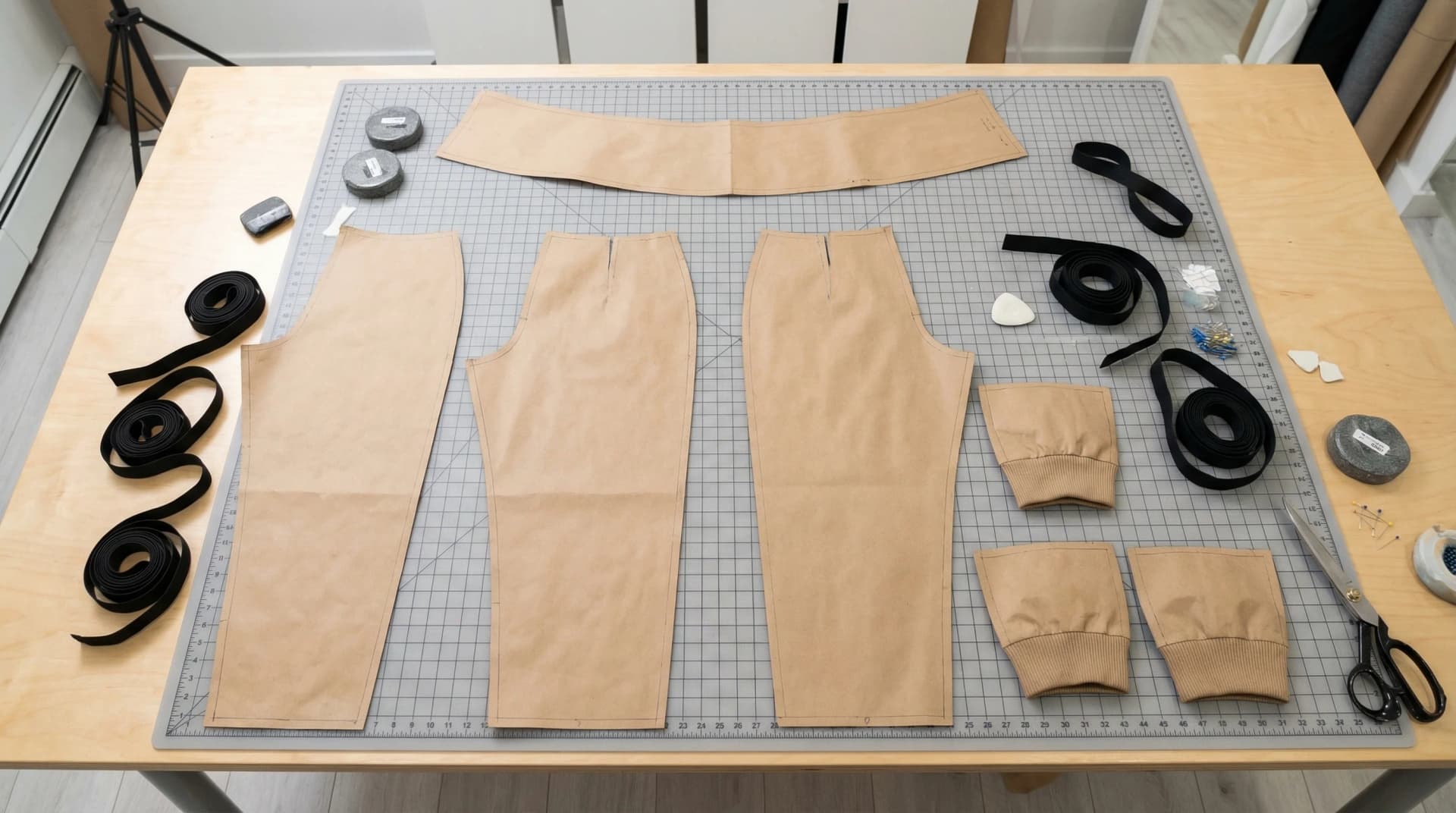
Why Joggers Are More Complex Than They Appear
Joggers look straightforward — two legs, a waistband, and a cuff. But in the factory, bottoms are consistently the most challenging garment category to produce well. The fit has to work across a wider range of body types than a top, the waistband construction is critical for comfort and durability, and the fabric has to move with the body without losing its shape.
At White Cotton, we manufacture five bottom styles — sweatpants, cargo joggers, shorts, and structured trousers — in fabrics ranging from 350 to 680 GSM. This guide walks through how joggers are made from start to finish, what to consider when developing your own, and the details that separate a great pair of joggers from an average one.
Fabric Selection for Joggers
French Terry (280–500 GSM)
The most popular fabric for joggers worldwide. French Terry provides the right balance of warmth, breathability, and drape.
- —280–350 GSM — Lightweight, ideal for spring/summer or year-round wear in moderate climates. Good drape, comfortable for daily wear
- —350–420 GSM — Mid-weight, the sweet spot for premium joggers. Enough structure to hold its shape, soft enough for comfort
- —420–500 GSM — Heavyweight. Substantial, structured, often chosen by streetwear and luxury brands. These joggers have real weight and presence on the body
Brushed Fleece (350–580 GSM)
For winter and cold-weather joggers, brushed fleece is the upgrade. The brushed interior adds warmth and that premium cosy feel that customers notice immediately.
- —Best suited for 400+ GSM
- —The brushed interior adds perceived thickness without adding bulk
- —Popular for matching sets (hoodie + joggers) where the fabric needs to be consistent
Cotton Twill (200–380 GSM)
For structured joggers that sit between athletic wear and casual trousers, Cotton Twill offers a completely different character.
- —Smooth, diagonal weave creates a more tailored appearance
- —Does not stretch like jersey or fleece — sizing and pattern work are more critical
- —Ideal for cargo-style joggers, utility pants, and workwear-inspired bottoms
- —Often garment-dyed for a washed, lived-in aesthetic
Cotton Canvas (220–480 GSM)
Our heaviest option for bottoms. Cotton canvas joggers and cargo pants are extremely durable, structured, and have a workwear character.
- —Best for cargo pants, utility trousers, and heavy-duty bottoms
- —The fabric softens significantly after washing — enzyme wash or stone wash is common
- —Our Canvas Cargo Pants use 380 GSM organic cotton canvas
For a complete look at fabric options, visit our fabric library or read the fabric sourcing guide.
The Manufacturing Process: Step by Step
Step 1: Pattern Making
Jogger patterns are more complex than top-body patterns because they need to account for movement in multiple directions — walking, sitting, bending, squatting. Key pattern elements include:
- —Rise — The measurement from the waistband to the crotch seam. Too short causes discomfort; too long looks sloppy. Getting the rise right is one of the most common sampling challenges
- —Thigh width — Determines whether the jogger reads as slim, regular, or relaxed
- —Knee break — Where the leg shape transitions from thigh to lower leg
- —Taper — How aggressively the leg narrows from knee to ankle. A strong taper creates the classic jogger silhouette
- —Inseam length — Needs to work across the full size range. Grading the inseam correctly is critical
Step 2: Grading
Grading bottoms is harder than grading tops. The relationship between waist, hip, thigh, and length changes disproportionately across sizes. A size S-to-XL grade that works perfectly for a sweatshirt may produce a jogger that fits well in S and M but poorly in XL.
We recommend brands provide fit models in at least two sizes (typically M and XL) when developing joggers. This catches grading issues early and saves sample rounds.
Step 3: Cutting
Jogger panels are larger than top-body panels, which means:
- —More fabric consumption per garment
- —Cutting layout (nesting) needs careful planning to minimise waste
- —Fabric direction matters — jersey and fleece have a grain, and cutting against it causes the legs to twist after washing
At White Cotton, we use manual cutting for production runs under 500 pieces and assisted cutting for larger volumes, always following the fabric grain.
Step 4: Sewing
A pair of joggers involves significantly more sewing operations than a t-shirt or sweatshirt:
Ready to manufacture your collection?
Factory-direct from Barcelos, Portugal. MOQ 50 units per style, colour and size.
Request a QuoteNo commitment · No obligation
- 1.Inseam — Joining the inner leg panels from crotch to ankle
- 2.Outseam — Joining the outer leg panels (or constructing side pockets at this stage)
- 3.Crotch seam — The most stressed seam in any pair of trousers. Must be reinforced
- 4.Waistband attachment — Elastic channel, drawcord insertion, waistband facing
- 5.Pocket construction — Side pockets, back patch pockets, cargo pockets (each adds complexity)
- 6.Cuff attachment — Ribbed cuffs, elastic hems, or open hems
- 7.Drawcord insertion — Threading the drawcord through the waistband channel
- 8.Bartacks — Reinforcement stitches at stress points (pocket corners, crotch, drawcord openings)
A simple sweatpant involves 15–20 sewing operations. A cargo jogger with multiple pockets can exceed 30.
Step 5: Finishing
- —Thread trimming — Especially critical for joggers because interior threads can cause irritation against the skin
- —Pressing — Joggers are steamed and pressed for presentation, with particular attention to the waistband and cuffs
- —Wash treatments — Enzyme wash, stone wash, or garment dyeing if specified. These are particularly popular for joggers as they soften the fabric and add character
Step 6: Quality Control
Every pair is checked for:
- —Waistband elasticity and symmetry
- —Drawcord centring and length
- —Pocket placement and alignment (both sides must match)
- —Inseam and outseam measurements (both legs must be identical)
- —Crotch seam reinforcement
- —Cuff tension consistency
For more on our QC process, read quality control in garment manufacturing.
Waistband Construction
The waistband is the most engineered part of any jogger. There are several approaches.
Elastic Waistband with Drawcord
The industry standard for casual joggers. An elastic strip is enclosed in a fabric channel, with a drawcord threaded through for adjustable fit.
- —Elastic width — Typically 25–40mm. Wider elastic distributes pressure more comfortably
- —Elastic quality — Must maintain recovery after hundreds of stretch cycles. Cheap elastic loses tension within months
- —Drawcord type — Flat woven tape, round cord, or thick rope. Each gives a different aesthetic. Drawcord ends can be tipped with metal aglets, knotted, or left raw
- —Drawcord exit — Centre front through eyelets, or side exits. Centre front is standard
Ribbed Waistband
A wide rib-knit panel replaces the elastic channel. Creates a cleaner, more athletic look. The ribbing provides the stretch and recovery.
- —Typically 5–8cm wide
- —Must be carefully proportioned to the body fabric — too tight and it digs in, too loose and it sags
- —Often used in matching sets for a cohesive look with a crewneck sweatshirt
Flat Front Waistband
Used on more structured joggers and trousers. A flat waistband with elastic only in the back panel, sometimes with belt loops.
- —Creates a hybrid between casual joggers and tailored trousers
- —More complex to construct — higher production cost
- —Popular in contemporary fashion and elevated streetwear
Cuff Styles
Ribbed Cuffs
The classic jogger cuff. Creates the tapered, gathered ankle silhouette that defines the jogger shape.
- —Rib should match the waistband composition and weight
- —Cuff width typically 5–8cm
- —Cuff tension is critical — too tight restricts movement, too loose negates the tapered look
Elastic Hem
An elastic strip inserted into a turned hem. Creates a similar gathered effect to ribbed cuffs but with a smoother, less sporty appearance.
Open Hem
A straight-cut leg with a standard hem. Technically not a "jogger" at this point — more of a sweatpant or casual trouser. But some brands want the sweatpant fabric with a straighter leg opening.
Pocket Options
- —Side seam pockets — Cut into the side seam, invisible from outside. Clean, minimal
- —On-seam pockets — Similar to side seam but angled for easier hand access
- —Patch pockets — Sewn onto the surface (typically back pockets). Simple to construct
- —Cargo pockets — Side-leg pockets, often with flaps. Add significant complexity and cost. Our cargo jogger pattern includes double cargo pockets with flap closure
- —Hidden zip pockets — Concealed zip at the hip or thigh. Popular for activewear and travel-oriented designs
- —Pocket lining — Can be self-fabric (same as body) or lightweight lining fabric (for heavyweight joggers, this keeps pockets from adding bulk)
Sizing Challenges Specific to Bottoms
Bottoms are the most returned garment category in fashion e-commerce, and the most common reason is fit. Here is why, and what brands can do about it.
- —Body proportion variance — Waist-to-hip ratios vary far more than chest measurements. A size M waist does not guarantee a size M hip or thigh
- —Rise preference — Some customers want a high rise, others a low rise. The same size jogger will fit completely differently depending on where the customer wears their waistband
- —Length — A 30-inch inseam fits someone 170cm tall very differently from someone 185cm tall. Some brands offer two inseam options; others grade the inseam more aggressively across sizes
Our recommendation: Provide a detailed size chart with waist, hip, thigh, inseam, and front rise measurements. Include a flat-lay photo with measurement indicators. The more information you give your customers, the fewer returns you process.
MOQ and Pricing
Our minimum order for bottoms varies by complexity:
- —Basic sweatpants — 75 pieces per colour and fit (50 for 2+ colourways)
- —Cargo joggers — 100 pieces per colour and fit (due to construction complexity)
- —Shorts — 75 pieces per colour and fit
Unit pricing for joggers is higher than for tops due to:
- —More fabric consumption per garment (roughly 1.5–2x a sweatshirt)
- —More sewing operations (15–30+ operations vs 8–12 for a top)
- —Waistband and cuff components (elastic, drawcords, ribbing)
- —Higher QC requirements
For a full breakdown of production costs, read our clothing production costs guide.
At White Cotton
We manufacture joggers, sweatpants, cargo pants, and shorts in our Barcelos factory. Every step from cutting to packing happens in-house, with the same quality standards we apply to our hoodies and sweatshirts.
If you are developing a bottoms line, send us your tech pack or sketches and we will provide a detailed quotation within 48 hours. We can guide you through fabric selection, construction options, and help you get the fit right from the first sample. Related: sweatshirt production guide, hoodie manufacturing guide, GSM fabric weight chart.

Pedro Carreira
Founder of White Cotton, a textile manufacturer in Barcelos, Portugal. Producing custom clothing collections for brands across 15+ countries.
Continue Reading
Screen Printing vs DTG vs Embroidery: Choosing the Right Decoration Method
Your First Clothing Sample: What to Expect, What It Costs & Timeline
Manufacturing Oversized Streetwear: Patterns, Fabrics & Production Tips
Polo Shirt Manufacturing: Piqué, Jersey & Premium Construction
![Hoodie Manufacturing Guide: Fabric, GSM, Costs & Construction [2026]](/_next/image?url=%2Fimages%2Fgenerated%2Fblog%2Fhoodie-manufacturing-guide.webp&w=1920&q=75)
Hoodie Manufacturing Guide: Fabric, GSM, Costs & Construction [2026]
Start your collection today
Factory-direct from Barcelos, Portugal. MOQ 50 units. Get a free quote.
Request a Quote← Previous
How to Find a Clothing Manufacturer: The Step-by-Step Process
Next →
Polo Shirt Manufacturing: Piqué, Jersey & Premium Construction
Ready to start manufacturing?
MOQ 50 pieces · Free quote · Factory-direct from Portugal